Arkansas Roots
Jim Quessenberry was born and raised in Northeast Arkansas — Mississippi River bottom country, where BBQ has been a way of life for as long as there have been pigs and pecan trees. Arkansas BBQ doesn't get the press that Memphis or Texas BBQ gets, but the people who know know. Arkansas pitmasters fall somewhere between the Memphis dry-rub-and-sauce-on-the-side tradition and the Texas long-slow-low-and-pure approach. We use hickory and pecan. We cook whole hog when we can. We're never in a hurry.
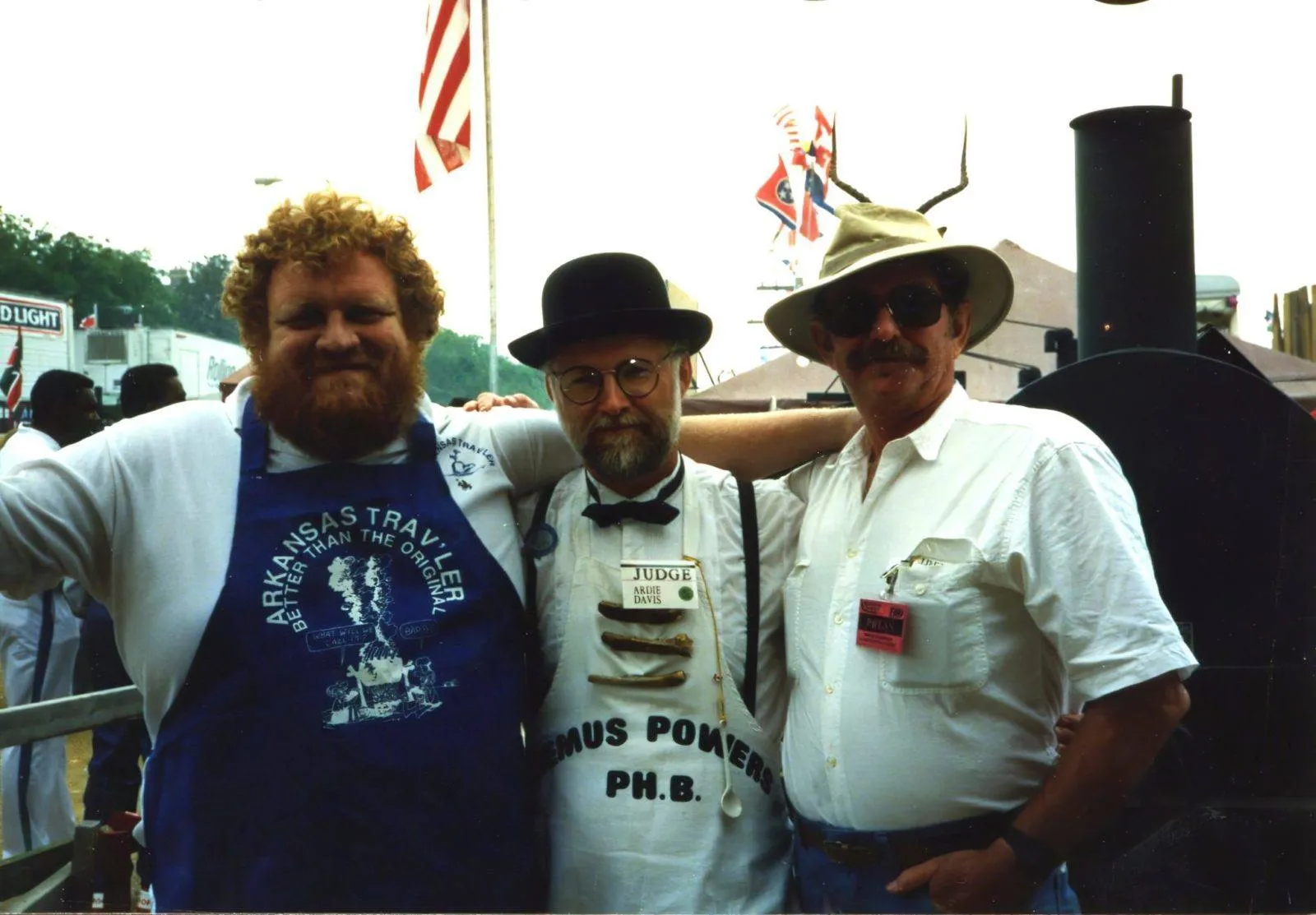
Jim grew up in that tradition, then took it on the road. By the early 1980s, he was hauling his rig — christened "The Arkansas Trav'ler" — to competitions across the country. Memphis, Des Moines, Kansas City, Cleveland, even Lisdoonvarna, Ireland. The Arkansas Trav'ler was the size of a camper trailer and could cook four whole hogs at once. (He'd later walk Ardie Davis through how he built it on a 1987 cassette tape that still survives.)
His sauce — eventually bottled as Sauce Beautiful — and his rub — Spice Beautiful — were the same recipes that kept winning. They weren't fancy. They didn't try to be fifteen things. They were tuned, tested, and tweaked over years of competition cooking until they did one job perfectly: make great BBQ taste even better.
Lisdoonvarna — Two-Time World Champion
In 1985, Jim flew his pit, his sauce, and his sense of humor across the Atlantic to Lisdoonvarna, Ireland with his sister Becky for the inaugural Irish Cup Invitational Barbecue Festival. He won 1st place in the beef division with his championship prime rib and took home the Overall Championship — the first well-known World Championship in competition BBQ. He cooked an entire hog for an audience of mostly bewildered Europeans who had never seen anything like it. He won.
Two years later, in 1987, Jim came back to Lisdoonvarna and did it again — winning the 3rd International Cooking Competition and becoming a two-time World Champion. The only man from Arkansas to ever hold that title. That second trip sealed his place in the earliest pantheon of international competition BBQ.
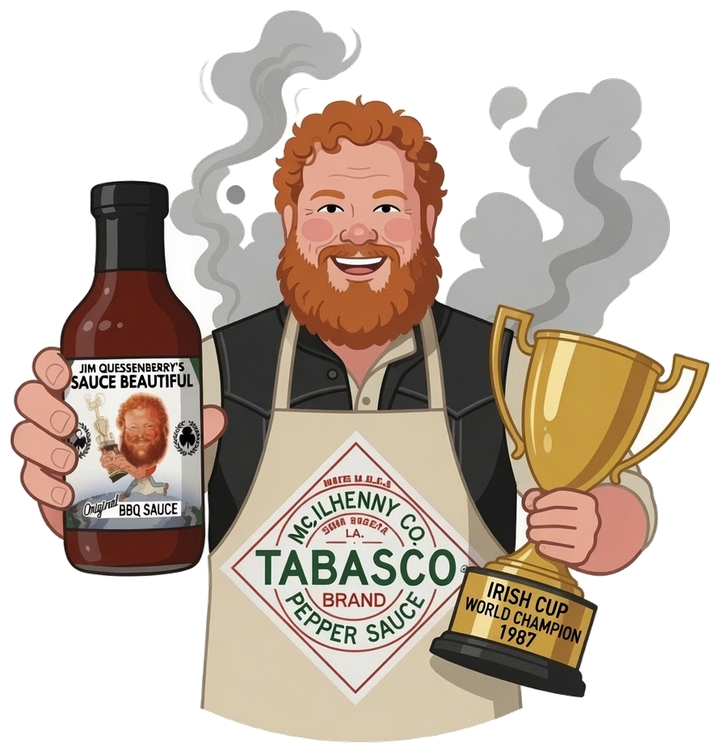
The line that defined him — "Cook that sumbitch, we'll eat it" — was Jim in a nutshell. Confident, generous, a little bit profane, and always ready to feed you. Whether you were a Memphis judge, an Arkansas governor, an Irish farmer, or a barbecue historian who happened to wander into his team booth on a sunny day in Tom Lee Park, you got the same treatment: a cold beer, a tall tale, and the best plate of barbecue you'd ever had in your life.
The Hall of Fame Years
Through the 1980s and 1990s, Jim and his crew piled up wins. KCBS American Royal top three. Memphis in May team booth headliner. BBQ Hall of Fame semi-finalist. He worked on a never-published Barbecue Whole Earth Catalog with his friend Ardie Davis, a project they laughed about for years. He told stories about Bill Clinton, Elvis, his hogs, his rig, and his sauce, and you couldn't tell where one ended and the next began. That was the point.
In 2019 — 19 years after Jim's passing — the BBQ Central Show correspondents publicly named him a serious contender for induction into the Barbecue Hall of Fame. Steve Ray and Jon Solberg both backed his case, citing his pioneering competition career and the impact he had on the people who came after him.
The Loss
Jim Quessenberry passed away in February 2000. He was 51 years old. He left behind his wife Donna, his sons Lee and Michael, his right-hand-man Arthur, a notebook full of recipes, and a rig still smelling like hickory smoke.
For a while, the sauce went quiet.
The Brothers Q
Lee and Michael Quessenberry grew up under that smoke. They were the hands and feet of their father's pit from the time they could carry a basting brush. After Jim's passing, they spent years carrying the recipes around in their heads, in their freezers, in their family kitchens — until the time was right to bring it back.
Today, the Brothers Q hand-bottle Sauce Beautiful and Spice Beautiful in Arkansas using their father's original 1980s championship recipes. Nothing changed. Nothing modernized. Same sauce that beat the Irish in '85, same rub that took home the trophies, same handwritten formula from the same notebook.
The label has Jim on it. The bottle has his story behind it. And every batch goes out the door with the same wink Jim would have given you: Cook that sumbitch. We'll eat it.