The Arkansas Trav'ler
Pitmaster Gazette · Championship BBQ Edition
BBQ History
Carolina BBQ Sauce Explained: Eastern, Western, and Mustard Styles
Ask a pitmaster in North Carolina what Carolina BBQ sauce is and you’ll get a fight before you get an answer. There is no single Carolina sauce. There are at least three distinct Carolina sauce traditions, each tied to a specific region, each with its own ingredients, each with passionate defenders who think the other two don’t count.
Here’s the honest version: all three are great, all three are authentic, and all three represent a different philosophy of how BBQ sauce should work. If you only know the tomato-sweet sauce from grocery store bottles, Carolina sauce is going to feel like a different country.
The three (or four) Carolina sauce styles
The Carolinas have four regions you should know about:
- Eastern North Carolina — vinegar-and-pepper sauce, no tomato
- Piedmont / Western North Carolina (Lexington) — vinegar-and-pepper with a little ketchup
- South Carolina Midlands (Mustard Belt) — yellow mustard base
- South Carolina Coastal / Up-Country — more similar to Eastern NC or Western NC depending on where you are
The Mason-Dixon Line of Carolina BBQ runs roughly through the middle of North Carolina. East of it, you’re in vinegar country. West of it, you start seeing ketchup. Cross into central South Carolina and suddenly everything is mustard. It’s one of the most fractured and interesting regional food traditions in America.
Eastern North Carolina sauce: vinegar and pepper, period
Ingredients (a typical recipe):
- 2 cups apple cider vinegar (or white vinegar — purists argue about this)
- 2 tablespoons crushed red pepper flakes
- 1 tablespoon hot sauce (Texas Pete, usually)
- 1 tablespoon kosher salt
- 1 tablespoon brown sugar (some recipes skip it entirely)
- 1 teaspoon black pepper
That’s it. No tomato. No ketchup. No molasses. Just sharp vinegar, floating red pepper flakes, and salt.
What it’s for: Eastern Carolina sauce is designed for whole-hog barbecue. The traditional Eastern NC pit cook is a whole hog, cooked low and slow over coals for 10-14 hours until the meat is falling apart. Then the whole thing is chopped — every part of the hog, crispy skin and all — and mixed together. That chopped whole hog meat is incredibly rich and fatty, and what it needs is not more sweetness or more tomato — it needs acid. The vinegar cuts the fat, the red pepper adds bite, the salt seasons the chopped meat.
You don’t really “sauce” Eastern Carolina BBQ. You mop it onto the hog during the cook, and then you mix a little more into the chopped meat at the end. It’s thin enough to absorb into the meat rather than coat it.
How it tastes: Sharp. Tangy. Spicy. Like hot sauce vinegar with a little extra body. On the first bite, it feels like there’s no “sauce” at all — it just makes the pork taste more like pork. That’s the whole point.
Western NC / Lexington sauce: the “dip”
Around Lexington, North Carolina — about 100 miles west of Raleigh — the sauce starts to change. Pitmasters there started adding ketchup to the vinegar base, creating what locals call “the dip.”
Ingredients:
- 1 cup apple cider vinegar
- 1/2 cup ketchup
- 2 tablespoons brown sugar
- 1 tablespoon hot sauce
- 1 teaspoon red pepper flakes
- 1 teaspoon salt
- 1 teaspoon black pepper
Still thin. Still vinegar-forward. But with a reddish color and a touch of tomato sweetness. It’s closer to what most Americans recognize as “BBQ sauce” but it’s nowhere near as thick or sweet as Kansas City style.
What it’s for: Western NC style focuses on pork shoulder rather than whole hog. Lexington is famous for its shoulder joints — places like Lexington Barbecue, Stamey’s in Greensboro, The Barbecue Center — that cook pork shoulder over hickory and chop or slice it. The Lexington dip works beautifully on sliced or chopped shoulder because the tomato adds enough body to coat the meat, but the vinegar still provides the acidic punch.
South Carolina mustard sauce: the yellow one
Cross from North Carolina into South Carolina and in the central part of the state — the “midlands” around Columbia — you’ll find something that will stop you in your tracks: mustard-based BBQ sauce.
Ingredients:
- 1 cup yellow mustard
- 1/2 cup apple cider vinegar
- 1/4 cup brown sugar
- 2 tablespoons honey
- 1 tablespoon Worcestershire
- 1 teaspoon hot sauce
- 1 teaspoon black pepper
- 1 teaspoon cayenne
- Salt to taste
The mustard base comes from the heavy German immigration into central South Carolina in the 1700s and 1800s. German immigrants brought their love of mustard with them, and when the BBQ tradition met the German food tradition, you got mustard sauce.
What it’s for: South Carolina mustard sauce (sometimes called “Carolina Gold”) is used on pulled pork, pork ribs, and smoked sausages. The mustard gives it body without being heavy, the vinegar and sugar give it tang and sweetness, and the overall profile is completely different from any other American BBQ sauce.
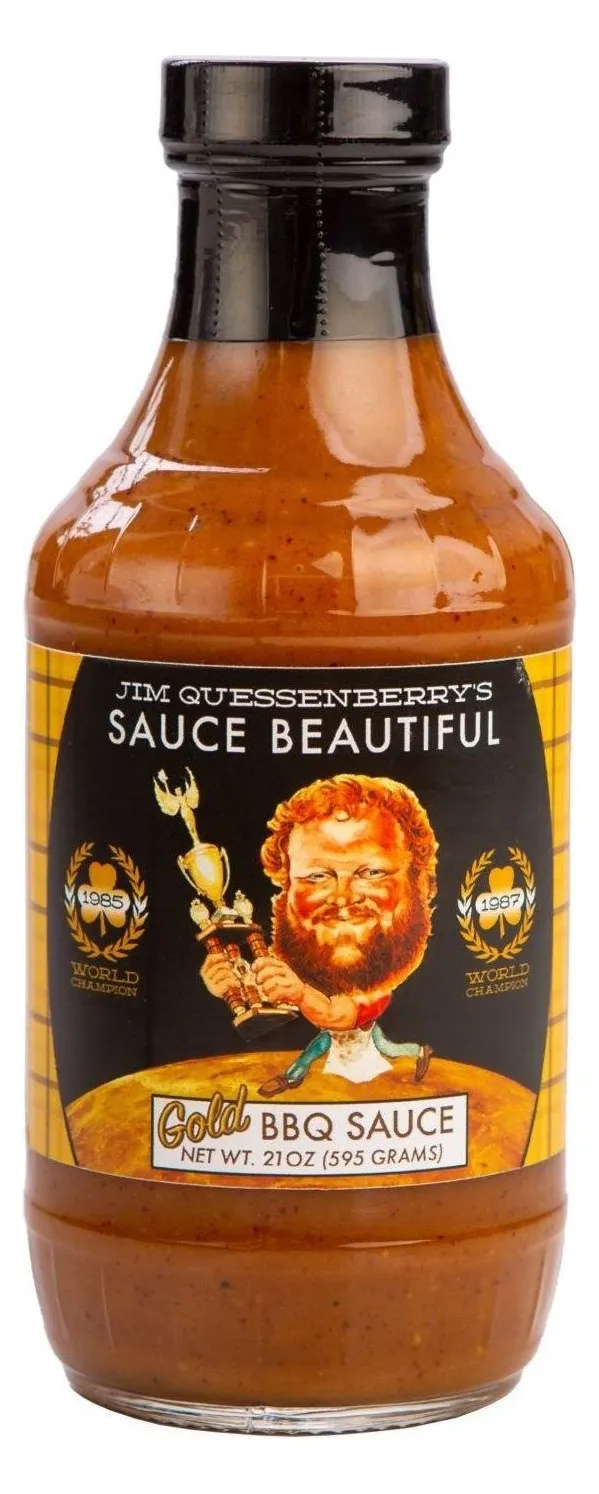
This is the style that Sauce Beautiful Gold lives in. It’s Jim’s take on a Carolina Gold — mustard-forward, tangy, sweetened with brown sugar, and built to finish pork shoulder and chicken. It’s not a traditional SC mustard sauce in every detail (Jim was an Arkansas guy, not a Carolina guy) but it’s deeply in the Carolina Gold tradition.
Why Carolina BBQ uses thinner sauces
This is the key insight that ties all three Carolina styles together: Carolina BBQ sauce is thin because Carolina BBQ is pit-cooked whole hog and pork shoulder, and those meats don’t need thick sauce.
Kansas City sauce is thick because it evolved around burnt ends, brisket, and heavily glazed ribs — meats where a sticky, caramelized, thick sauce is part of the final texture. Memphis sauce is medium-thick because Memphis ribs are often served both dry and wet, and the sauce plays a supporting role.
Carolina BBQ is different. The meat is the point. The pit cook takes 10-14 hours. By the time the hog comes off, the flavor of the meat is already so rich, smoky, and fat-laden that a thick, sweet sauce would fight it. Instead, Carolina sauces are designed to brighten the meat — to cut the fat, add acid, add pepper, and let the hog itself stay the center of attention.
This is also why Carolina pitmasters are sometimes dismissive of heavily sauced BBQ. From their perspective, if you need that much sauce, you’re covering up a weakness in the meat.
How to use each Carolina style
Eastern NC vinegar sauce
- Best for: whole hog, pulled pork, chopped pork sandwiches
- Application: mop during cooking, mix into chopped meat at the end, serve on the side as a finishing splash
- Pairs with: white bread, slaw (dressed with more vinegar sauce), hush puppies
Western NC / Lexington dip
- Best for: pork shoulder (pulled or sliced), pork chops
- Application: mix a small amount into chopped or pulled pork; serve the rest on the side
- Pairs with: red slaw (slaw made with the same dip instead of mayo), hush puppies
South Carolina mustard sauce
- Best for: pulled pork, pork ribs, smoked sausage, grilled chicken
- Application: brush on in the last 20 minutes of a cook; serve as a dipping sauce; toss pulled meat in it
- Pairs with: collards, cornbread, macaroni and cheese
Making your own Carolina-style sauce at home
The beautiful thing about Carolina sauces is how simple they are. A ten-ingredient list, ten minutes on the stove, done. You don’t need to cook any of them down for hours the way you would a Kansas City style.
For an Eastern NC sauce: combine all ingredients in a jar, shake, let sit in the fridge overnight so the pepper flakes bloom, done.
For a Western NC dip: same thing, let it rest overnight.
For a South Carolina mustard sauce: warm the ingredients together in a saucepan for 5 minutes so the honey and sugar dissolve, cool, refrigerate overnight, done.
If you want a ketchup-based homemade sauce with more weight to it, we’ve got a separate post: Jim’s Original BBQ Sauce Recipe.
How Sauce Beautiful Gold fits in
Jim Quessenberry was an Arkansas pitmaster, not a Carolina one, but he spent enough time on the competition circuit to appreciate every regional style. When he built his gold sauce in the 1980s, he was explicitly drawing on the South Carolina mustard tradition — the tangy yellow base, the honey-and-vinegar balance, the use of mustard as a vehicle for flavor rather than just a condiment.
Sauce Beautiful Gold is what happens when a championship pitmaster who loves Carolina Gold takes the tradition and puts his own spin on it. It’s got more complexity than a basic Carolina mustard sauce — more spices, more backbone — but it lives in that same family. If you’ve never tried a mustard-based BBQ sauce and you’re curious where to start, Gold is the entry point.
For more on the red sauce family, see our Memphis BBQ sauce guide. For the white sauce world, see our white BBQ sauce guide.
Cook that sumbitch. We’ll eat it.
— End of dispatch · Hand-packaged in Arkansas —