The Arkansas Trav'ler
Pitmaster Gazette · Championship BBQ Edition
BBQ History
Arkansas BBQ: The Forgotten Regional Tradition
Ask ten people to name the great American BBQ regions and you’ll hear the same five every time: Texas, Kansas City, Memphis, the Carolinas, and maybe Alabama. What you almost never hear — even though the state sits right in the middle of the BBQ belt — is Arkansas.
That’s a mistake. Arkansas has its own distinct BBQ tradition, its own pitmasters, its own regional style, and a history that goes back as far as anywhere in the South. Arkansas BBQ is often described as a blend of Memphis and Texas, but that undersells it. It’s its own thing — with its own preferred cuts, its own sauce style, and its own way of thinking about barbecue.
This is the story of Arkansas BBQ — where it came from, how it differs from its neighbors, the pitmasters who built it, and how Jim Quessenberry fits into the tradition.
Where Arkansas sits on the BBQ map
Geographically, Arkansas is the BBQ crossroads of the South. Memphis is 15 minutes across the Mississippi River from West Memphis, Arkansas. Dallas and Fort Worth are four hours west. Kansas City is six hours north. New Orleans is seven hours south. Whatever tradition you can name, Arkansas borders it.
What that means for Arkansas BBQ is that the state has absorbed influences from everywhere and built its own synthesis:
- From Memphis: pork-shoulder focus, tomato-based finishing sauces, ribs cooked low and slow
- From Texas: beef brisket, hotlinks, pepper-forward rubs, smoking over hickory and pecan
- From the Carolinas (via migration): vinegar-forward mop sauces, whole-hog tradition in some areas
- From Kansas City (distantly): molasses-sweetened red sauces
- From Native and African-American traditions: the underlying techniques of pit cooking, mop sauces, and slow smoking
But Arkansas doesn’t just copy any of these. It picks and chooses. A traditional Arkansas BBQ joint is more likely to be pork-shoulder focused than beef-focused, more likely to use a tomato-based sauce than a vinegar one, and more likely to smoke with hickory than mesquite. In those choices, Arkansas leans east — toward Memphis and the deep South rather than west toward Texas.
The distinguishing features of Arkansas BBQ
If you had to describe Arkansas BBQ in five bullets:
- Pork-shoulder focused, with ribs and smoked chicken as secondary specialties
- Tomato-based sauces with moderate sweetness and noticeable vinegar tang — Memphis-adjacent but often sweeter
- Hickory smoke as the dominant wood, sometimes mixed with pecan
- Rub-heavy pork — Arkansas pitmasters generally use bolder, more complex rubs than central Texas (which tends toward salt-and-pepper Dalmatian rubs)
- Sauce served on the side, not cooked into the meat — the Memphis “wet rib vs dry rib” distinction matters in Arkansas too
That’s distinct from Memphis (which is more whole-hog and rib focused and leans more toward “dry” rib styles), distinct from Texas (which is brisket-focused and minimally sauced), and distinct from Kansas City (which is much sweeter and covers a wider range of meats).
Famous Arkansas BBQ joints
Every great BBQ tradition has its landmark restaurants. Arkansas’s list is shorter than Texas’s or Memphis’s but every bit as good:
McClard’s Bar-B-Q (Hot Springs)
Founded in 1928 and still run by the McClard family, McClard’s is probably the most famous BBQ joint in Arkansas. Bill Clinton — who grew up in Hot Springs — has been a lifelong regular, and the restaurant is famously one of his favorite hometown spots. McClard’s is known for pork ribs, pork shoulder, and a distinctive “tamale spread” dish that layers BBQ with Arkansas Delta-style hot tamales. Their sauce is Arkansas-classic: tomato base, vinegar tang, moderate sweetness.
Sims Bar-B-Que (Little Rock)
A Little Rock institution with multiple locations, specializing in ribs and chopped pork. Sims is famous for a distinctive thick, vinegar-and-tomato-based sauce with a heavy black pepper profile — often called one of the most distinctive sauces in Arkansas BBQ.
Whole Hog Cafe (Little Rock)
A more modern joint (opened in the early 2000s) but already an Arkansas institution. Started by a competition BBQ team with real KCBS competition experience. They sell a line of sauces and rubs commercially, in addition to the restaurant’s cooked meats.
Wright’s Barbecue (Johnson / Springdale)
A more recent addition in Northwest Arkansas but one of the most buzzed-about BBQ joints in the country. Featured on national lists, known for brisket and pork belly burnt ends in addition to traditional Arkansas pork.
Craig’s Bar-B-Q (DeValls Bluff)
A small-town legend in the middle of the Arkansas Delta, serving old-school pork BBQ for generations. Their sauce is Delta-style — thinner, spicier, with more black pepper than the usual Arkansas formula.
Penguin Ed’s Bar-B-Que (Fayetteville)
A Northwest Arkansas institution, serving ribs and brisket to University of Arkansas students and Ozark locals for decades.
The Arkansas Delta and the BBQ tradition
The Arkansas Delta — the eastern portion of the state along the Mississippi River — has its own BBQ culture that deserves special mention. The Delta is where Arkansas BBQ is closest to Memphis in style: pork-shoulder focused, tomato-vinegar sauces, and a heavy African-American pitmaster tradition that parallels the Memphis scene.
Some of the best small-town BBQ in America is in the Arkansas Delta — places like Jones Bar-B-Q Diner in Marianna (one of the oldest Black-owned BBQ joints in the country, dating to the early 1900s), Craig’s in DeValls Bluff, and smaller joints in Forrest City, Helena, and Pine Bluff. These places don’t show up on national “best of” lists the way the glossy Texas joints do, but they represent the deepest and oldest parts of the Arkansas tradition.
Jim Quessenberry: the Arkansas championship pitmaster
Jim Quessenberry (1948-2000) grew up in Arkansas in the 1950s and 60s, surrounded by the regional BBQ tradition. He started cooking competitively in the 1970s as BBQ competitions were first organizing into the formal events we’d recognize today. He cooked at Memphis in May (the biggest BBQ competition in the mid-South), at regional Arkansas events, and eventually at national and international events.
In 1985, Jim traveled to Lisdoonvarna, Ireland with his sister Becky and won the inaugural Irish Cup International Barbecue Contest. He returned in 1987 and won the 3rd International Cooking Competition too, becoming a two-time World Champion. Those two wins made him one of the earliest international BBQ champions and put Arkansas BBQ on a stage it had never been on before.
Jim cooked on a rig he built himself — the Arkansas Trav’ler, a custom trailer-mounted smoker that he used on the competition circuit. The Trav’ler was a piece of Arkansas folk engineering, built to handle pork shoulders and ribs at the scale a real competition required. Jim competed from 1978 through 1994, refining his rub and sauce recipes through hundreds of competitions and thousands of pork shoulders.
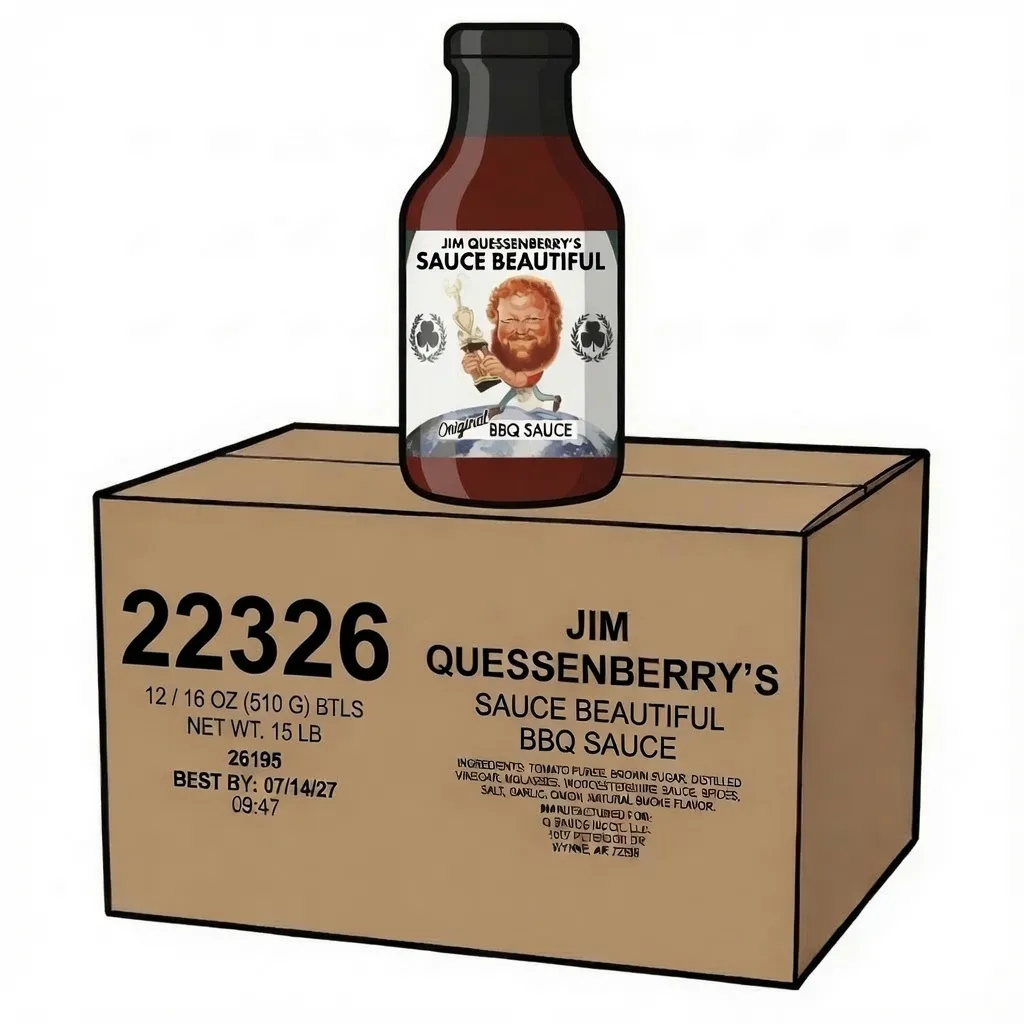
His sauce — Sauce Beautiful Original — is fundamentally an Arkansas-style sauce. It’s tomato-based, moderately sweet, vinegar-balanced, and finishes with a long smoky depth that comes from a sauce built by a pitmaster who actually competed. It’s the kind of sauce an Arkansas pitmaster who’d tasted every regional style would build: leaning Memphis in its bones, but with enough personality to stand on its own.
When Jim died in 2000, the recipe stayed in the family. His sons Lee and Michael restarted the bottling operation in the 2010s, using his original 1980s formulas unchanged. Every bottle today is hand-made in Arkansas by the Quessenberry family.
How Arkansas BBQ differs from Memphis
This is the comparison most people get wrong — they assume Arkansas BBQ is just Memphis BBQ with an Arkansas zip code. It’s not quite.
Similarities:
- Both are pork-focused
- Both use tomato-based finishing sauces
- Both cook with hickory
- Both have heavy African-American pitmaster traditions
Differences:
- Memphis is more whole-hog oriented; Arkansas is more pork-shoulder oriented
- Memphis ribs come in “dry” and “wet” styles as a famous distinction; Arkansas ribs are almost always sauced (wet)
- Memphis sauce is often thinner and more vinegar-forward; Arkansas sauce is often slightly thicker and sweeter
- Arkansas has more beef influence from Texas migration than Memphis does — you’ll find brisket on Arkansas menus more often than on classic Memphis menus
The differences aren’t huge, but they’re real. An experienced BBQ eater can tell an Arkansas plate from a Memphis plate if you put them side by side.
How Arkansas BBQ differs from Texas
The differences here are much bigger.
| Feature | Arkansas BBQ | Central Texas BBQ |
|---|---|---|
| Dominant meat | Pork shoulder, pork ribs | Beef brisket |
| Sauce | Tomato-based, sweet-tangy | Thin au jus or sauce on the side (minimal) |
| Rub | Complex, layered, some sugar | Simple, salt-and-pepper heavy (Dalmatian) |
| Wood | Hickory, pecan | Post oak, mesquite |
| Cooking vessel | Offset smokers, pits, sometimes cinder-block pits | Mostly offset smokers |
| Philosophy | Sauce and rub are part of the flavor | Meat is the star; sauce is optional |
An Arkansas pitmaster and a central Texas pitmaster would recognize each other as cousins, but they’d argue about every single step of the process.
What Arkansas BBQ doesn’t have that it should
Arkansas BBQ deserves more recognition than it gets. The reasons it doesn’t:
-
No central city ambassador. Texas has Austin, Memphis has Memphis, Kansas City has Kansas City. Arkansas is spread across Little Rock, Fayetteville, Hot Springs, and the Delta, with no single dominant “Arkansas BBQ city” that gets national coverage.
-
Smaller overall tourist infrastructure. Texas BBQ tourism is a multi-million-dollar industry. Arkansas doesn’t have the same level of BBQ trail promotion or food media attention.
-
Competition with Memphis next door. When national food writers think of the mid-South, they go to Memphis. Arkansas gets overlooked as “basically Memphis” even though it has its own traditions.
-
No famous national brand from Arkansas until recently. Texas has Stubb’s (originally). Kansas City has KC Masterpiece. Memphis has Corky’s. Arkansas didn’t have a national BBQ brand until relatively recently — which is part of why we’re doing what we’re doing with Sauce Beautiful.
Carrying the Arkansas tradition forward
Lee and Michael Quessenberry didn’t start Sauce Beautiful as a business decision — they started it because their father’s recipes deserved to still exist. Jim was one of the great Arkansas championship pitmasters, and his work was about to disappear into memory along with the competition circuit he cooked on.
Every bottle of Sauce Beautiful Original is a piece of the Arkansas BBQ tradition, made the way Jim made it, in Arkansas, by the family. That’s not marketing copy — it’s literal.
If you care about regional American BBQ traditions, and you want to taste something that represents a specific regional voice that doesn’t get enough attention, Arkansas BBQ — and Jim Quessenberry’s sauce in particular — is worth your time.
For more on how the Sauce Beautiful recipes came together, see our how BBQ sauce is made guide. For the flavor comparison with other regional styles, see our Memphis BBQ sauce guide and Carolina BBQ sauce guide.
Cook that sumbitch. We’ll eat it.
— End of dispatch · Hand-packaged in Arkansas —