The Arkansas Trav'ler
Pitmaster Gazette · Championship BBQ Edition
Product Guide
How BBQ Sauce Is Made: A Pitmaster Explains
Most people never think about how BBQ sauce is made. You grab a bottle off a grocery store shelf, you squeeze it on ribs, and you don’t ask any more questions. And most of the time, that’s fine — BBQ sauce is BBQ sauce. But if you’ve ever wondered why some sauces taste like actual barbecue and some taste like sweetened ketchup, the answer is in how the sauce is made.
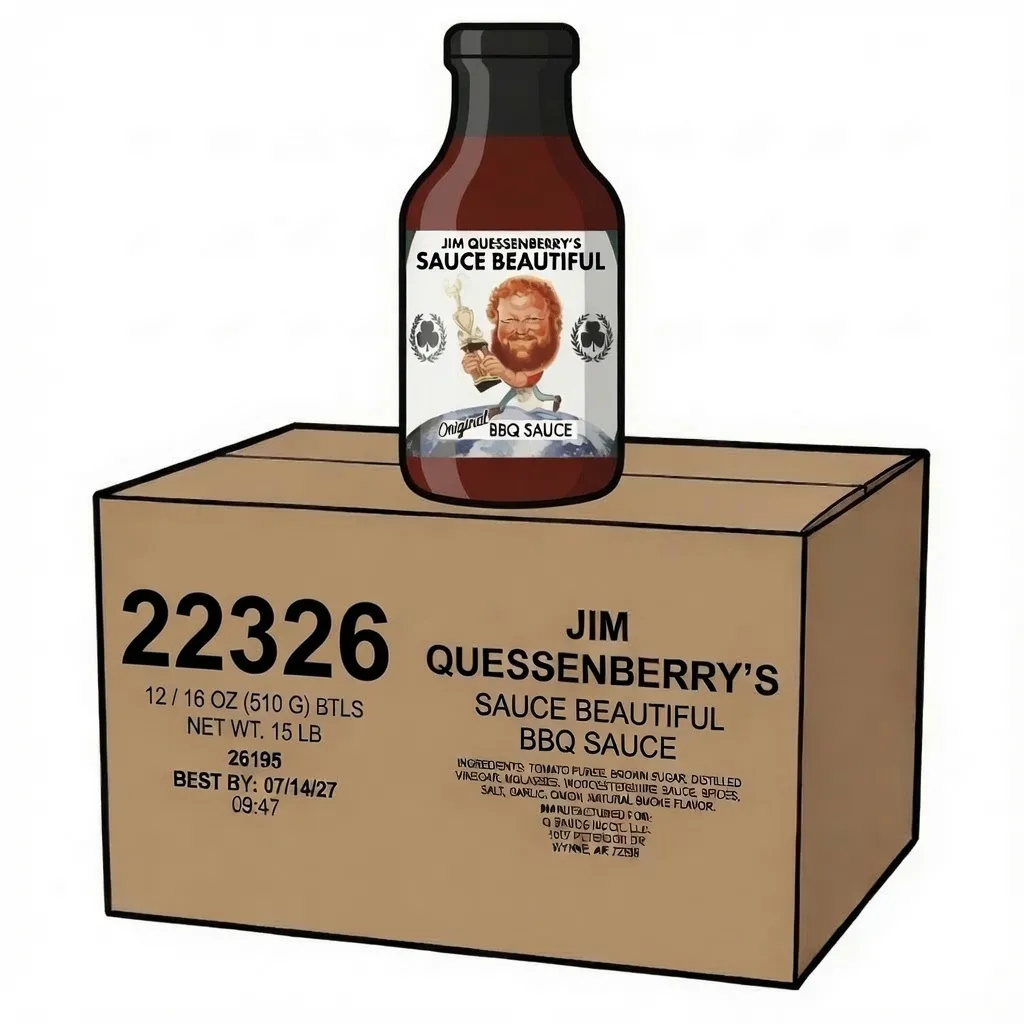
There’s a big difference between a mass-market sauce made in a 10,000-gallon stainless steel vat and a small-batch sauce made 50 gallons at a time by a family that’s been making it the same way for 40 years. Here’s the full picture — how the small-batch pitmasters actually do it (the Quessenberry brothers, Lee and Michael, who make Sauce Beautiful in Arkansas using their dad Jim’s original 1980s recipes), how the mass-market brands do it differently, and why the process matters as much as the recipe.
The core steps
Every BBQ sauce — from Sweet Baby Ray’s to a pot you cook in your kitchen — goes through roughly the same steps:
- Gather the base ingredients
- Combine and mix
- Cook it down
- Rest / let the flavors marry
- Package / bottle
- Store
But at every step, there are choices that separate small-batch from mass-market. Let’s walk through them.
Step 1: The base ingredients
A tomato-based BBQ sauce (like Sauce Beautiful Original) is built on a handful of core ingredients:
- Tomato base — usually ketchup, tomato sauce, or tomato paste (sometimes all three)
- Vinegar — apple cider vinegar is the classic; white vinegar is cheaper and more neutral
- Sugar — brown sugar, molasses, honey, or (in mass-market sauces) high-fructose corn syrup
- Worcestershire sauce — for umami depth
- Mustard — yellow mustard or mustard powder for tang
- Spices — paprika, garlic powder, onion powder, black pepper, sometimes cumin, chili powder, cloves, cayenne
- Salt
- Optional: liquid smoke (real smoke condensed into a liquid flavoring), hot sauce, additional Worcestershire
Where small-batch makers differ from mass-market:
- Small-batch uses real brown sugar and molasses; mass-market often uses high-fructose corn syrup because it’s much cheaper
- Small-batch uses real spices; mass-market sometimes uses “natural flavors” — a catch-all term that can include artificial flavor compounds
- Small-batch uses apple cider vinegar; mass-market often uses distilled white vinegar for a more neutral, consistent flavor
- Small-batch uses ketchup or tomato paste; mass-market uses tomato concentrate reconstituted with water
This isn’t always a quality judgment — mass-market sauces can taste great. But when you read a small-batch sauce label and a mass-market sauce label side by side, the difference in ingredient sourcing becomes obvious fast.
Step 2: Combine and mix
In a small-batch kitchen, this is where the pitmaster’s hand matters most. The Quessenberry brothers measure out each ingredient by weight (not by volume — volume is unreliable for sticky ingredients like molasses) and combine them in a heavy-bottomed pot.
The order of combining matters more than most people realize:
- Ketchup/tomato base first — gives you a canvas to work on
- Liquid ingredients next — vinegar, Worcestershire, molasses — stirred in until smooth
- Sugar — dissolved in the warm liquid base
- Dry spices last — sprinkled in and whisked so they don’t clump
Clumpy spices are a sign of a rushed sauce maker. A pro adds the dry ingredients gradually and stirs continuously so the spices distribute evenly without forming dry pockets.
Mass-market version: In a commercial kitchen, this step is done by a giant mixing blade in a 500-gallon kettle, and the ingredients are often dumped in all at once in a specific order that the machine can handle. It’s faster, it’s more consistent, but it’s not different in principle.
Step 3: Cook it down
This is where magic happens — and where most home cooks get impatient.
A good BBQ sauce is cooked at a bare simmer (just under boiling — small bubbles breaking the surface, not a rolling boil) for 30 to 60 minutes, depending on the recipe. The goal is not to “cook the ingredients” — the ingredients are already cooked. The goal is to:
- Reduce the liquid — so the sauce thickens to the right body
- Caramelize the sugars — so the sauce develops complex, deep flavors instead of just tasting sweet
- Marry the spices — so the individual spices blend into a single “BBQ sauce flavor” rather than tasting like a list of ingredients
- Activate the Maillard reaction — the browning reaction that makes roasted, cooked foods taste “cooked”
You cannot rush this step. Cook it too hot and you’ll scorch the bottom and get a burnt, bitter note you can’t undo. Cook it too cold and the flavors never blend. Cook it for 10 minutes instead of 45 and you get a sauce that tastes raw and sharp.
Small-batch pitmasters stir constantly with a wooden spoon or a long spatula, scraping the bottom every minute or two. In a small batch of 5-10 gallons, one person can handle this easily. In a mass-market 500-gallon kettle, the stirring is done by machine — which works fine but has no feel for when a specific batch needs 5 more minutes.
Step 4: The rest
This is the step that separates the craftsmen from the factory. A well-made BBQ sauce rests.
After cooking, small-batch makers cool the sauce to room temperature, cover it, and let it sit overnight — 12 to 24 hours — before bottling. In that rest period, three things happen:
- Spices bloom — the flavors of garlic, onion, paprika, cumin all develop and integrate
- Vinegar softens — raw-tasting vinegar mellows into a rounder acidity
- Sugar settles — the caramelized notes deepen and stop being “new”
A sauce tasted straight out of the pot tastes completely different from the same sauce tasted the next day. Every championship pitmaster knows this. Jim Quessenberry used to make his sauce two days before competitions specifically so it had time to rest and develop.
Mass-market version: Most commercial BBQ sauces skip the rest entirely. They cook, they bottle, they ship. Speed is everything. The sauce still tastes fine — but you’re tasting a “fresh” sauce, not one that’s had time to integrate.
If you make BBQ sauce at home, resting it overnight is the single easiest thing you can do to improve the finished product. See Jim’s original BBQ sauce recipe for a homemade version with the rest built in.
Step 5: Bottling
Small-batch bottling is slow and deliberate. A typical small-batch process heats the finished sauce back to around 180-190°F (the “hot fill” temperature that pasteurizes the product and kills any contamination), pours it into sterilized bottles, caps them immediately, and inverts the bottles briefly so the hot sauce sterilizes the inside of the cap. The bottles cool on the counter, the lids seal with a satisfying pop, and they’re ready to label.
This is called hot-fill processing, and it’s how small-batch food producers safely shelf-stabilize their products without having to pressure-can everything. It works because the combination of high acidity (from the vinegar and tomato) plus high temperature plus a sealed container creates an environment where nothing harmful can grow.
Mass-market version: Commercial producers use in-line hot-fill equipment that heats, fills, caps, and cools thousands of bottles per hour. Same basic principle, massively scaled up.
Shelf life: A properly hot-filled BBQ sauce will keep, unopened, for 18-24 months at room temperature. Once opened, refrigerate and use within 6 months for best flavor. See our guide on whether BBQ sauce goes bad for more detail.
What “small batch” actually means
“Small batch” is a marketing term that’s been used by everyone from craft brewers to mass-market yogurt brands, and it’s largely unregulated. So what does it mean when a BBQ sauce calls itself small batch?
For Sauce Beautiful, it means literally this: the sauce is made in small, hand-measured batches by Lee and Michael Quessenberry in a kitchen they control directly. They taste every batch. They adjust the seasoning if a specific batch needs it. They can stop production if the tomatoes they’re getting aren’t right. They know exactly how long each batch simmered and exactly how long it rested.
By contrast, a typical “small batch” claim from a big brand might mean the sauce is made in 1,000-gallon runs on an automated production line — still technically smaller than a 10,000-gallon run, but not hand-made in any meaningful sense.
The difference shows up in the finished product. A genuine small-batch sauce has slight variation between batches — which is a feature, not a bug. Every batch is tuned by hand. A mass-market sauce tastes identical every time because it’s been engineered to. Neither is wrong, but they’re not the same thing.
Why it matters
When you buy a bottle of BBQ sauce, you’re buying a finished product, but you’re also buying all the decisions that went into making it. Mass-market brands are optimizing for:
- Shelf stability
- Consistency across millions of bottles
- Cost per ounce
- Appealing to the broadest possible taste
Small-batch makers are optimizing for:
- Flavor
- Authenticity
- The recipe the pitmaster actually wants to make
- Customer loyalty from the people who notice the difference
If you’ve never tasted a real small-batch BBQ sauce, the first bottle is a revelation. You notice the layers of flavor that aren’t in the grocery store version. You notice the acidity is sharper and more real. You notice that you can actually taste individual ingredients — the molasses, the mustard, the smoke — instead of just a homogenized “BBQ sauce” flavor.
Sauce Beautiful Original is Jim Quessenberry’s 1980s competition recipe, made by his sons in Arkansas in small batches and bottled by hand. That’s what small batch means when you mean it.
Cook that sumbitch. We’ll eat it.
— End of dispatch · Hand-packaged in Arkansas —