# Championship BBQ Rub Recipe (The Pitmaster's Version) Most **bbq rub recipe** posts on the internet are some version of the same thing: a list of ingredients, no ratios that make sense, no explanation of why any of it is in there. You could cook 50 rubs from 50 blogs and end up with 50 mediocre rubs that all taste like "sweet smoky something." This is different. This is the way Jim Quessenberry — the man who put the Q in Q — thought about rubs. He cooked on the BBQ competition circuit through the '70s, '80s, and '90s and became a **two-time World Champion** at Lisdoonvarna, Ireland (1985 and 1987). He wasn't a cookbook pitmaster. He was a guy with a pot, a smoker, a pickup truck, and a formula he'd refined over more than 15 years of cooking for judges on the competition circuit. The rub you can buy now — [Spice Beautiful Original](/shop/rubs/spice-beautiful-original/) — is built on the same philosophy. If you want to make a version in your kitchen first, here's the structure and the science behind it. ## The four jobs a BBQ rub has to do Every great rub does four things at once. If yours only does three, it's just seasoning. If it does all four, it's a rub. 1. **Salt the meat** — every rub needs enough salt to penetrate and season the surface 2. **Feed the bark** — sugar caramelizes during a low-and-slow cook and builds that dark, lacquered crust 3. **Layer the flavor** — warm spices, sweet spices, pungent spices, and a little heat so there's something happening at every bite 4. **Make it look like barbecue** — paprika, chili, and other red/brown spices give the meat that mahogany color judges and eaters both reward Once you understand these four jobs, you can mix any rub you want. You're just adjusting the ratios based on what you're cooking. ## The base ratio (pork-focused) This is the formula to memorize. Everything else is variation. - **1/2 cup dark brown sugar**, packed - **1/4 cup sweet paprika** - **1/4 cup kosher salt** (Diamond Crystal — if you use Morton's, cut this to 3 tablespoons because Morton's is denser) - **2 tablespoons garlic powder** - **2 tablespoons onion powder** - **2 tablespoons freshly cracked black pepper** - **1 tablespoon chili powder** (ancho or a good basic chili powder — not cayenne) - **1 tablespoon ground cumin** - **1 tablespoon mustard powder** - **1-2 teaspoons cayenne** (to taste — 1 for family, 2 for real people) Makes roughly 1.5 cups. Enough for 2 racks of ribs plus 2 pork shoulders, or 4-5 whole chickens. Store in a mason jar in a cool, dark spot and use within 3 months for peak flavor. ## What each ingredient is doing **Brown sugar** — this is your bark builder. As the meat cooks low and slow, the sugar melts into the surface moisture, caramelizes in the heat, and forms a dark, crusty layer. Without sugar, you get no bark. White sugar works in a pinch, but brown sugar has molasses in it, and molasses adds depth. **Paprika** — this is mostly about color and a mild, sweet-pepper flavor. Sweet Hungarian or Spanish paprika is ideal. Smoked paprika adds a second layer of smoke flavor but can overpower the wood smoke on a real smoker — use it sparingly if at all. **Kosher salt** — this is what seasons the meat. Do **not** use table salt. It's too fine, it packs too dense, and you'll oversalt everything. Diamond Crystal kosher is the championship standard because it distributes evenly and doesn't cake. **Garlic and onion powder** — savory depth. Don't use garlic salt or onion salt. You're controlling the salt separately. **Black pepper** — fresh cracked, coarse. Pre-ground pepper from a shaker has lost most of its flavor by the time you open it. Grind your own or buy a coarse restaurant grind. **Chili powder and cumin** — these are your warm, Tex-Mex-adjacent notes. Chili powder adds complexity (it's already a blend — ancho, cumin, oregano, garlic); cumin adds earthiness. Together they make a rub taste like "real BBQ" instead of "sweet-and-smoky." **Mustard powder** — this is the ingredient most rub recipes skip, and it's one of the most important. Mustard powder adds a tangy, sharp note that cuts through the sweetness and makes the rub taste rounder. It also activates with moisture and helps the rub bite into the meat. **Cayenne** — heat. Not "spicy for the sake of being spicy" heat — just enough to make your tongue pay attention. A championship rub is never fire-hot, but it's never bland either. ## How to adapt the base for different meats The base recipe above is a **pork rub**. It's built for pork shoulders, ribs, and pork belly — meats that benefit from sweetness and can handle 12+ hours of low heat. For other meats, adjust like this: ### For chicken - **Cut the sugar in half** (use 1/4 cup instead of 1/2 cup). Chicken skin burns much easier than pork — too much sugar and you get black instead of bark. - **Double the black pepper**. Chicken needs more savory bite. - **Add 1 tablespoon dried thyme** or **1 teaspoon dried sage**. Chicken takes to herbs in a way pork doesn't. - Pair with [Sauce Beautiful White](/shop/sauces/sauce-beautiful-white/) on the finish. We cover the full method in our [BBQ rub for chicken guide](/guides/bbq-rub-for-chicken/). ### For brisket or other beef - **Drop the sugar entirely** or cut it to 2 tablespoons. Beef doesn't need it — the fat is the flavor. - **Double the black pepper**. Brisket is a black-pepper meat. - **Drop the cumin and chili powder** — they're too Tex-Mex for a classic Texas brisket. Use a pinch of garlic powder and a pinch of onion powder instead. - At the extreme end: salt + coarse pepper only = the famous **Dalmatian rub** used on competition brisket. See our [BBQ rub for brisket guide](/guides/bbq-rub-for-brisket/). ### For ribs specifically Keep the base recipe as written, but consider using [Spice Beautiful Hickory](/shop/rubs/spice-beautiful-hickory/) instead — it's built around the same structure with a hickory-forward profile designed specifically for ribs. Our [rib rub guide](/guides/bbq-rub-for-ribs/) walks through the application. ## How to apply a rub (the right way) Mixing the rub is the easy part. Applying it separates good pitmasters from frustrated ones. 1. **Dry the meat first**. Pat it dry with paper towels. Wet meat makes rub clump. 2. **Apply a binder** — a thin coat of yellow mustard, olive oil, or even mayonnaise. The binder helps the rub stick. You won't taste it. 3. **Sprinkle from a height** — 10-12 inches above the meat. This makes the rub distribute evenly. Don't just dump it in one spot. 4. **Don't pat it down** at first. Let it sit on the meat for 5 minutes and absorb the moisture, then you can lightly press it if needed. 5. **Flip and repeat** on the other side. 6. **Rest**. For pork shoulder and brisket, let the rubbed meat rest in the fridge for 4-12 hours before cooking. For ribs, 30 minutes at room temp is plenty. For chicken, go straight to the smoker — chicken doesn't need a long rub rest. ## How long does homemade rub last? A homemade rub made with fresh spices will taste great for **about 3 months**, decent for 6 months, and noticeably flat after a year. Spices don't go "bad" in the dangerous sense — they just lose their aromatic oils and turn into brown dust. If you're cooking BBQ every other weekend, make the full 1.5-cup batch and you'll use it up before it goes stale. If you're only cooking once a month, make half a batch at a time. ## Or buy the bottled version Making your own rub is a great thing to do once. Or twice. Or when you want to impress somebody. But if you're cooking BBQ regularly and you want a rub built on 40 years of championship feedback, mixed with commercial-grade fresh spices, and sealed to stay fresh — that's what [Spice Beautiful Original](/shop/rubs/spice-beautiful-original/) is. It's the same philosophy as this recipe, refined across hundreds of competitions, bottled in Arkansas by Jim's sons. And if you want to save a few bucks, the [Pick 3 Combo](/shop/combos/pick-3-combo/) gets you the rub, the sauce, and a bonus for less than buying them separately. **Cook that sumbitch. We'll eat it.** [**→ Shop Spice Beautiful Original**](/shop/rubs/spice-beautiful-original/)
Pit Notes
From the Quessenberry recipe box
Championship BBQ Rub Recipe (The Pitmaster’s Version)
Most bbq rub recipe posts on the internet are some version of the same thing: a list of ingredients, no ratios that make sense, no explanation of why any of it is in there. You could cook 50 rubs from 50 blogs and end up with 50 mediocre rubs that all taste like “sweet smoky something.”
This is different. This is the way Jim Quessenberry — the man who put the Q in Q — thought about rubs. He cooked on the BBQ competition circuit through the ’70s, ’80s, and ’90s and became a two-time World Champion at Lisdoonvarna, Ireland (1985 and 1987). He wasn’t a cookbook pitmaster. He was a guy with a pot, a smoker, a pickup truck, and a formula he’d refined over more than 15 years of cooking for judges on the competition circuit.
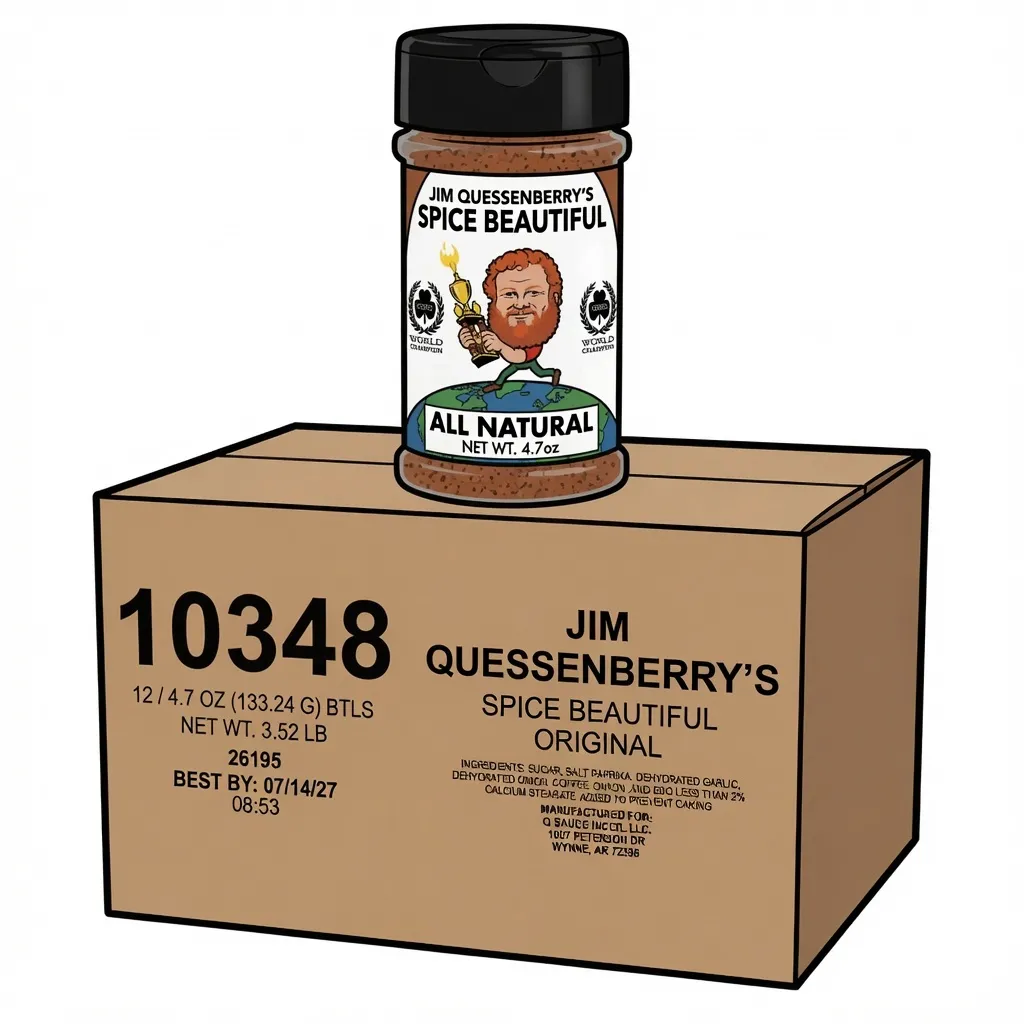
The rub you can buy now — Spice Beautiful Original — is built on the same philosophy. If you want to make a version in your kitchen first, here’s the structure and the science behind it.
The four jobs a BBQ rub has to do
Every great rub does four things at once. If yours only does three, it’s just seasoning. If it does all four, it’s a rub.
- Salt the meat — every rub needs enough salt to penetrate and season the surface
- Feed the bark — sugar caramelizes during a low-and-slow cook and builds that dark, lacquered crust
- Layer the flavor — warm spices, sweet spices, pungent spices, and a little heat so there’s something happening at every bite
- Make it look like barbecue — paprika, chili, and other red/brown spices give the meat that mahogany color judges and eaters both reward
Once you understand these four jobs, you can mix any rub you want. You’re just adjusting the ratios based on what you’re cooking.
The base ratio (pork-focused)
This is the formula to memorize. Everything else is variation.
- 1/2 cup dark brown sugar, packed
- 1/4 cup sweet paprika
- 1/4 cup kosher salt (Diamond Crystal — if you use Morton’s, cut this to 3 tablespoons because Morton’s is denser)
- 2 tablespoons garlic powder
- 2 tablespoons onion powder
- 2 tablespoons freshly cracked black pepper
- 1 tablespoon chili powder (ancho or a good basic chili powder — not cayenne)
- 1 tablespoon ground cumin
- 1 tablespoon mustard powder
- 1-2 teaspoons cayenne (to taste — 1 for family, 2 for real people)
Makes roughly 1.5 cups. Enough for 2 racks of ribs plus 2 pork shoulders, or 4-5 whole chickens. Store in a mason jar in a cool, dark spot and use within 3 months for peak flavor.
What each ingredient is doing
Brown sugar — this is your bark builder. As the meat cooks low and slow, the sugar melts into the surface moisture, caramelizes in the heat, and forms a dark, crusty layer. Without sugar, you get no bark. White sugar works in a pinch, but brown sugar has molasses in it, and molasses adds depth.
Paprika — this is mostly about color and a mild, sweet-pepper flavor. Sweet Hungarian or Spanish paprika is ideal. Smoked paprika adds a second layer of smoke flavor but can overpower the wood smoke on a real smoker — use it sparingly if at all.
Kosher salt — this is what seasons the meat. Do not use table salt. It’s too fine, it packs too dense, and you’ll oversalt everything. Diamond Crystal kosher is the championship standard because it distributes evenly and doesn’t cake.
Garlic and onion powder — savory depth. Don’t use garlic salt or onion salt. You’re controlling the salt separately.
Black pepper — fresh cracked, coarse. Pre-ground pepper from a shaker has lost most of its flavor by the time you open it. Grind your own or buy a coarse restaurant grind.
Chili powder and cumin — these are your warm, Tex-Mex-adjacent notes. Chili powder adds complexity (it’s already a blend — ancho, cumin, oregano, garlic); cumin adds earthiness. Together they make a rub taste like “real BBQ” instead of “sweet-and-smoky.”
Mustard powder — this is the ingredient most rub recipes skip, and it’s one of the most important. Mustard powder adds a tangy, sharp note that cuts through the sweetness and makes the rub taste rounder. It also activates with moisture and helps the rub bite into the meat.
Cayenne — heat. Not “spicy for the sake of being spicy” heat — just enough to make your tongue pay attention. A championship rub is never fire-hot, but it’s never bland either.
How to adapt the base for different meats
The base recipe above is a pork rub. It’s built for pork shoulders, ribs, and pork belly — meats that benefit from sweetness and can handle 12+ hours of low heat.
For other meats, adjust like this:
For chicken
- Cut the sugar in half (use 1/4 cup instead of 1/2 cup). Chicken skin burns much easier than pork — too much sugar and you get black instead of bark.
- Double the black pepper. Chicken needs more savory bite.
- Add 1 tablespoon dried thyme or 1 teaspoon dried sage. Chicken takes to herbs in a way pork doesn’t.
- Pair with Sauce Beautiful White on the finish. We cover the full method in our BBQ rub for chicken guide.
For brisket or other beef
- Drop the sugar entirely or cut it to 2 tablespoons. Beef doesn’t need it — the fat is the flavor.
- Double the black pepper. Brisket is a black-pepper meat.
- Drop the cumin and chili powder — they’re too Tex-Mex for a classic Texas brisket. Use a pinch of garlic powder and a pinch of onion powder instead.
- At the extreme end: salt + coarse pepper only = the famous Dalmatian rub used on competition brisket. See our BBQ rub for brisket guide.
For ribs specifically
Keep the base recipe as written, but consider using Spice Beautiful Hickory instead — it’s built around the same structure with a hickory-forward profile designed specifically for ribs. Our rib rub guide walks through the application.
How to apply a rub (the right way)
Mixing the rub is the easy part. Applying it separates good pitmasters from frustrated ones.
- Dry the meat first. Pat it dry with paper towels. Wet meat makes rub clump.
- Apply a binder — a thin coat of yellow mustard, olive oil, or even mayonnaise. The binder helps the rub stick. You won’t taste it.
- Sprinkle from a height — 10-12 inches above the meat. This makes the rub distribute evenly. Don’t just dump it in one spot.
- Don’t pat it down at first. Let it sit on the meat for 5 minutes and absorb the moisture, then you can lightly press it if needed.
- Flip and repeat on the other side.
- Rest. For pork shoulder and brisket, let the rubbed meat rest in the fridge for 4-12 hours before cooking. For ribs, 30 minutes at room temp is plenty. For chicken, go straight to the smoker — chicken doesn’t need a long rub rest.
How long does homemade rub last?
A homemade rub made with fresh spices will taste great for about 3 months, decent for 6 months, and noticeably flat after a year. Spices don’t go “bad” in the dangerous sense — they just lose their aromatic oils and turn into brown dust.
If you’re cooking BBQ every other weekend, make the full 1.5-cup batch and you’ll use it up before it goes stale. If you’re only cooking once a month, make half a batch at a time.
Or buy the bottled version
Making your own rub is a great thing to do once. Or twice. Or when you want to impress somebody. But if you’re cooking BBQ regularly and you want a rub built on 40 years of championship feedback, mixed with commercial-grade fresh spices, and sealed to stay fresh — that’s what Spice Beautiful Original is.
It’s the same philosophy as this recipe, refined across hundreds of competitions, bottled in Arkansas by Jim’s sons. And if you want to save a few bucks, the Pick 3 Combo gets you the rub, the sauce, and a bonus for less than buying them separately.
Cook that sumbitch. We’ll eat it.
Pairs with Spice Beautiful — Original